Tag: Great American Flag Preservation Group

  • The Great American Flag
    The Great American Flag

    Continuing the conversation…..

    We are grateful to the Great American Flag Preservation Group‘s Josh Dorfman and AJ Rehberg for their patriotism, positivity and dedication to the Great American Flag. Thank you for your continued friendship.

    John Mikhael: Our last segment focused on the physical history of the Great American Flag; the inspiration, characters and construction of the flag. But, this flag actually has its own place in American history. What can you tell us about the Great American American Flag’s role in US history?

    Josh (Co-Founder: Great American Flag Preservation Group): That’s actually what excites us the most.  Everyone is impressed by the flag’s size, but it’s the history of the flag that is truly amazing.  I think one of the most interesting stories is the role it played in the Iran Hostage Crisis. 

    The flag’s construction overlapped with the early months of the Iran Hostage Crisis.  As the employees of Anchor Industries worked in shifts to assemble the flag, a renewed sense of patriotism gripped the country.  Understanding the flag needed a special purpose, it was dedicated to the 52 hostages during its inaugural unfurling in March 1980 at Anchor Industries in Evansville, Indiana. 

    Ten months later, when the hostages were finally released, organizers from the Great American Flag Committee contacted the federal government and requested permission to unfurl the flag at Andrews Air Force Base to welcome them home.  After overcoming a series of bureaucratic and security hurdles, the plan was approved.  With the help of the local chapter of Ironworkers and other volunteers, the flag was unfurled to greet the hostages upon their safe arrival at Andrews Air Force Base near DC.  Having heard about the flag, pilots of the planes carrying the hostages requested permission to conduct “fly-bys” before landing so that everyone aboard could view it.  So, after 444 days of captivity, the Great American Flag was there to welcome the hostages home.

    John: Wow! What an amazing visual. Their first glimpse of American soil and the Great Flag to welcome them home. I am getting goosebumps thinking about it!  What were some of the other notable displays of the flag?

    AJ Rehberg (Co-Founder: Great American Flag Preservation Group):  After being dedicated in Evansville, the next unfurling was on the National Mall in Washington, DC where it was laid at the base of the Washington Monument.  This was actually when the Guinness Book of World Records measured it and awarded it the title of largest flag in the world and largest textile ever produced. 

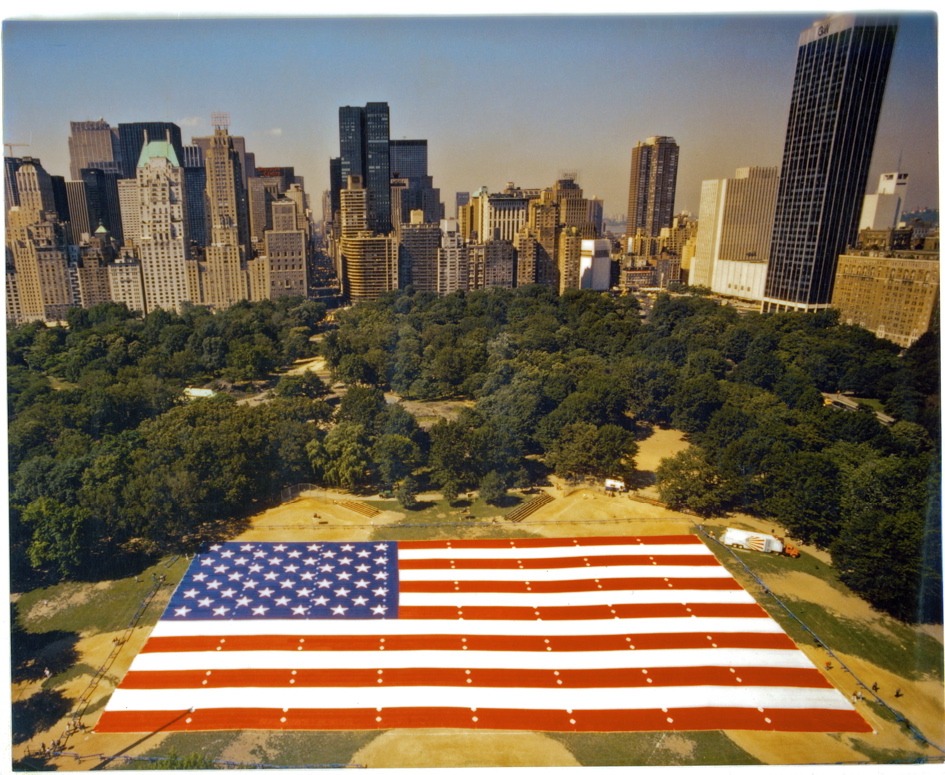
    Another interesting display was when it was unfurled in New York City’s Central Park.  It was initially planned to honor the crew members of NASA’s first orbital spaceflight aboard the Columbia.  Astronauts John Young and Bruce Crippen were supposed to be the guests of honor, but due to weather, the date of the unfurling had to be changed and they were not able to attend.  Instead, Len called in a few favors and Elizabeth Taylor stood in as the guest of honor. 

    Credit: Photo by G Paul Burnett/AP/Shutterstock (6549451a) Actress Elizabeth Taylor is seen on in New York’s Central Park during unfurling of “The Great American Flag,” a giant flag which is hoped will be flown from the Verrazano-Narrows Bridge on July 4th. The occasion was used to spur contributions to pay the estimated $650,000 it will take to hang the flag from the bridge which connects Brooklyn and Staten Island in New York Elizabeth Taylor, New York, USA

    After that, the flag remained in storage for the next couple years as Len continued to work tirelessly to raise the funds necessary to affix the flag to the Verrazano-Narrows Bridge.  When those efforts failed, he switched gears and turned to finding the flag a permanent home, which leads to my favorite display on the lawn of the White House.  

    When it became clear the fundraising efforts were out of reach, Len donated the flag to the federal government with the provision that it be displayed on the National Lawn every Flag Day.   And on June 14th, 1983, Flag Day, Ronald Reagan accepted Great American Flag as a gift to the American people on the White House lawn.

    Read the text of President Regan’s Speech here.

    John: Those are major historical milestones of the 1980s for sure. But why don’t I recall seeing the flag on the National Mall?

    AJ:  The problem was that despite committing to its annual unfurling in his speech, the necessary Executive Order was never issued to make it a permanent tradition.  It was displayed the following Flag Day, but it would unfortunately succumb to bureaucracy and spend years tucked away in a government storage facility.  There were attempts to honor the commitment and commemorate various events, but these never garnered sufficient support. Opera singer Mary Jo Jansson dreamt of a permanent display and monument along the Potomac River and led several unfurlings. Her nonprofit lobbied Congressman Claude Pepper to introduce bill H.R.810 in February 1989, meant to establish a permanent monument near DC. The bill never passed and energy around the flag faded.

    John: It seems like we were so close to seeing permanent action taken. But if the flag lost attention after the 1980s, how did it regain momentum?

    Josh: My parents’ purchase was timely. The auction occurred on July 4th, 2001 and the flag arrived at their home in southwestern Pennsylvania a few weeks before 9/11. After the tragic events of 9/11, my parents teamed with the local community to unfurl the flag and host a memorial service on September 23rd in Jennerstown, PA, a few miles from the Flight 93 crash site.  The tragedy sparked such a wave of patriotic energy that equipment companies, crane operators, helicopter pilots, and an army of volunteers donated their time and efforts alongside a security force of military veterans. So many people wanted to be involved and through that collective effort, we were able to accomplish in just 12 days what had been stalled over 12 years.

    New York Stock Exchange – September 11th, 2015. Photo By JM

    John: That last point seems critical. The attacks brought all Americans closer together.  We saw and felt that firsthand here in the NYC and NJ area in the immediate aftermath.  It was national wave of patriotism. That patriotism fueled the collaboration that your parents and the greater community were able harness. Impressive.

    Josh: You’re exactly right. I was only 8 years old, so I didn’t understand everything happening around me. But I distinctly recall the energy and collaboration and pride on display. We are seeking to channel those positive feelings toward fulfilling our nonprofit’s mission to restore the Great American Flag to is original condition and find it a permanent home.

    John: And we will do our best share the Great American Flag Preservation Group‘s mission.  That seems like a great stopping point for today.  Promise I won’t make our readers wait as long for our 3rd installment of the interview. I am excited to learn more about your mission and vision for the Great American Flag’s future. 

  • The Great American Flag

    The Great American Flag

    The hidden history of an American institution.

    Sometimes I feel like Bubba from Forrest Gump.  He loved his shrimp. I love an American Flag.  Giant Flags, Tiny Flags, Firehose Flags, Car Flags, Bourbon Barrel Flags….So imagine my reaction to seeing the Great American Flag for the first time!  

    We are excited to share our conversation with Josh Dorfman, CFA, CFP and AJ Rehberg, co-founders of the Great American Flag Preservation Group.  Josh is a full service financial advisor and also coaches the club hockey team at the American University. AJ is president of business consulting and government affairs firm based in Washington, DC.

    Their mission is the restoration and preservation of a colossal piece of American history.

    A helicopter flies over the Great American Flag

    John Mikhael (Founder | Pledge Project): So, give me a little background on the Great American Flag Preservation Group.

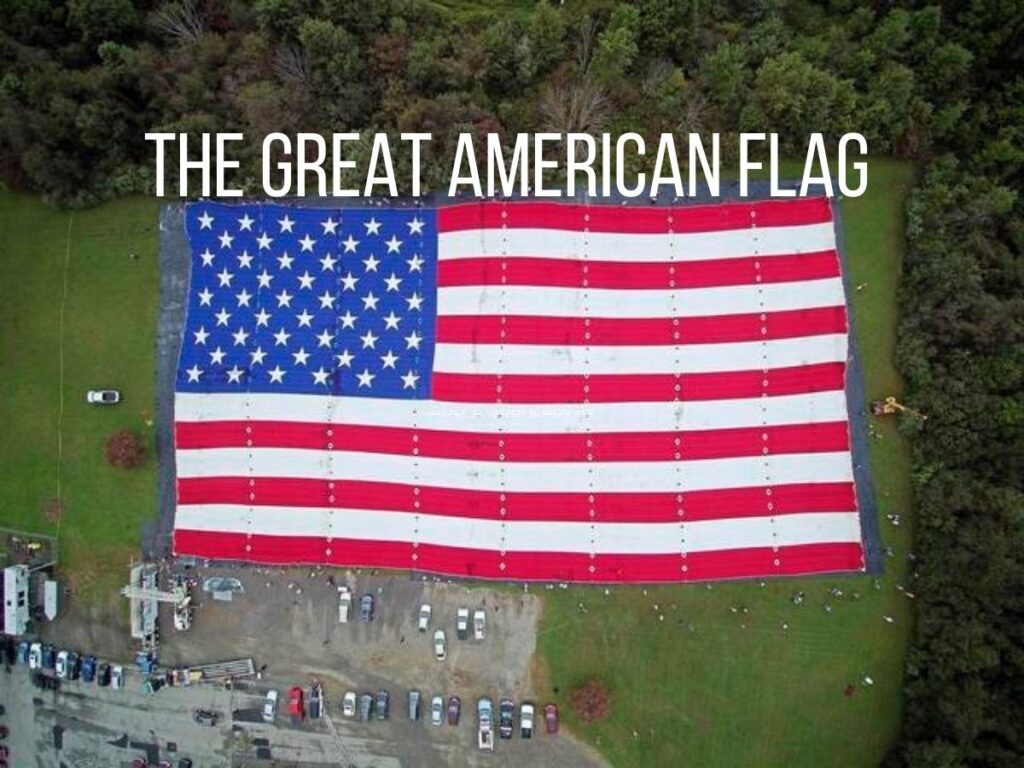
    AJ Rehberg (Co-Founder Great American Flag Preservation Group): Actually, it is a pretty funny story.  Josh and I met playing beer league hockey. One night after a game, we are at the bar comparing absurd eBay impulse buys when Josh told us a story about what happened one 4th of July. Josh and his mom attended a BBQ and when they returned home, Josh’s dad informed them that he had just bought a 7-ton, 86,500 sq. ft. American Flag on eBay.  To this day, that is still the most interesting eBay impulse buy I have ever heard of and this conversation spurred us to create the nonprofit.

    JM: Wait, he bought it on eBay?  Josh, you’re going to have to tell me more about that.   

    Josh (Co-Founder Great American Flag Preservation Group):: Yeah, so it was 4th of July, 2001 and eBay and the History Channel had teamed up to try and auction off the flag.  At that time, it was owned by the Kansas Cosmosphere & Space Museum who deemed it too big and cumbersome for the museum to maintain. So, my dad, Ted Dorfman, was home alone watching the History Channel when he saw a segment advertising the auction.  Like any patriotic American, he immediately got on eBay, placed a bid, and shortly thereafter he was the proud new owner of a very large piece of American history.

    JM:  So that’s how Army Veterans do impulse buys!  I can only imagine Mom’s reaction.   Now, it’s called the Great American Flag, but is it also the world’s largest American Flag?

    AJ: Not anymore. When it was constructed in 1980, it was not only the world’s largest American Flag, but the largest flag of any kind, appearing on the cover of the Guinness World Record Book.  Today the record for the largest American flag belongs to the Superflag, which is just over 128,000 sq. ft. and weighs 1.5 tons. So, while it is no longer the largest American flag, it is still the heaviest.  And given its history, I’d argue it’s the “most American” American flag in recent history. 

    A volunteer pitching in to unfurl the Flag

    JM:  Agreed.  You’ve shared some of that history with me but give me a better sense of what makes this flag so special.

    Josh: It’s kind of funny, when my dad purchased the flag, we really didn’t know much about it, except that it was big – and heavy- and required its own tractor trailer to transport it. After receiving the flag and displaying it shortly after 9/11, my parents started to fully understand and respect the history of the Great American Flag.

    JM:   This is a major historical point.  The Great American Flag was unfurled on September 23, 2001 in Jennerstown, PA only 6 miles from the Flight 93 crash site.  Many of us were comforted by the sight of the Great Flag without knowing anything about it.  Wow.  Let’s dig deeper.

    Jennerstown Speedway in the weeks after the September 11th Attacks

    Josh: The story is one of vision, perseverance, collaboration, and unity.  It was the brainchild of Len Silverfine who, like you and your organization, really believed in the unifying power of the American flag.  America had just been through some very polarizing events such as the Vietnam War and the Watergate Scandal. Len wanted to construct a flag that Americans from all walks of life could rally behind with a renewed sense of unity and purpose. 

    Not one to think small, Len’s grand vision of constructing a monumental American flag expanded to a flag that would hang from the Verrazano-Narrows Bridge to celebrate America’s bicentennial.  In 1976, the first version of the Great American Flag was finished and shipped to New York City.  With all the proper approvals in place and the help of forty ironworkers, this 71,000 sq.  ft. flag was hoisted up the cables of the Verrazano-Narrows Bridge, where it immediately succumbed to the dynamic forces of nature and was ripped to shreds by the winds. 

    On the Verrazano Narrows Bridge in New York City

    Demoralized but not deterred, Len took a hard look at what caused the flag to fail. He decided he needed to make an even bigger flag. A Flag that would become a permanent fixture on the Verrazano-Narrows Bridge.  The concept was to permanently store the flag in a weather-proof box affixed to the side of the bridge and install a complex rigging system on the bridge that would raise and lower the on holidays and for special events – like I said, Len was not the type of person to think small.  Most importantly, this flag would need to be constructed using the very best materials available. I use the term “constructed” because the design and assembly of the flag was much more like an engineering project that anything else. 

    JM: What a massive undertaking!

    Josh: So that’s when Len established the Great American Flag Fund. He set out to garner support and raise the funds necessary to begin work on the Great American Flag.  Len secured sponsorships from major American corporations like Revlon and Pfizer. The truth is much of the donations came from ordinary Americans. Folks that were inspired by Len’s vision and sense of patriotism.  Len recalls receiving envelopes in the mail from children who had filled them with pennies, nickels and dimes.  The project also received strong support from unions across the country. In one instance, union members passed a hat collecting donations during a labor strike to help Len realize his vision.

    Each Star is over 13 Feet Tall

    Simultaneously, Len began to assemble a team of industry leading experts to consult on the construction of the new flag.  Eventually, the Textile Technical Committee was formed.  This team of textile and engineering specialists worked on a strictly voluntary and non-profit basis. They did not charge the Great American Flag Fund a single dime for their services.  This team was comprised of several experts in the fields of fabric and textiles, threading, weatherization, and fabric dyes. 

    Scientific testing was done to understand the types of forces the flag would need to withstand. Plus testing the effects of sun and moisture on the colors of the flag.  All of this information was analyzed by the Textile Technical Committee.  Every aspect of the flag was meticulously researched and tested.  From the type of thread to the type of stitching, to the formulation of the dye.even the dying processes that would be used were tested.  Here’s an interesting side note. The fabric that was finally selected is the same type of fabric that is used for lawn mower bags.  After one year and countless planning sessions, the specifications for were finalized and it was time to assemble the flag. The committee selected Anchor Industries to assemble the flag at their facility in Evansville, Indiana.

    JM: Wait, it only took them a year to figure all of this out?

    AJ: I know, right?  I guess that’s what happens when people come together with a common purpose – they can achieve just about anything.

    JM: Well, you weren’t kidding, this Flag has quite a history and some very interesting characters involved.

    Josh: Oh, that is just the beginning, you haven’t heard the half of it.

    JM:  How’s that for a cliffhanger?!  Stay tuned for more on the Great American Flag!